

Fall color tours in historic American Revolutionary-era cemeteries are the perfect way to experience autumn while exploring early American history. Take your BillionGraves app along and take some photos to make the most of your experience.
Since this year is America’s 250th anniversary, 2026 is the perfect time to visit the graves of Founding Fathers and Revolutionary War heroes (even if it’s virtually!). The peak leaf-peeping season in these historic regions runs from late September to mid-to-late October in the north and into November in the south.

Here are 10 American Revolutionary-era cemeteries for you to explore:
Boston’s Freedom Trail Cemeteries
The first 3 cemeteries on our list are located on Boston’s Freedom Trail, a 2.5-mile, brick-lined route that leads you to 16 historically significant sites.
- Granary Burying Ground, King’s Chapel Burying Ground, and Central Burying Ground.
- Highlights: Mature trees that turn vibrant orange and gold in autumn frame slate and colonial-era headstones. Final resting places of patriots like Paul Revere, Samuel Adams, and victims of the Boston Massacre.
- Fall Color Tours Peak Foliage: Mid-to-late October.
1) Granary Burying Ground: Boston, Massachusetts
Established in 1660, the Granary Burying Ground is Boston’s most visited historic cemetery with more than one million visitors each year. It contains approximately 2,345 gravestones, with more than 5,000 people believed to be buried there.
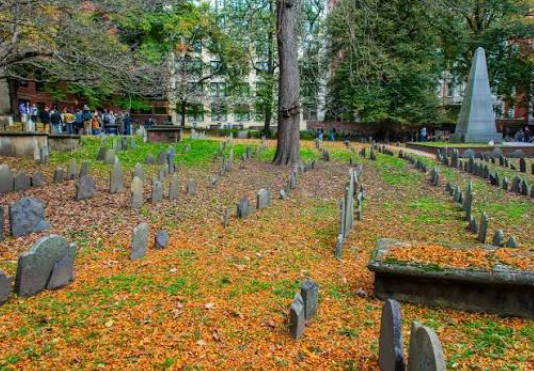
Granary Burying Ground has some amazing monuments with American Revolution-era gravestone art, decorated with winged skulls, cherubs, willow trees, and other symbols.
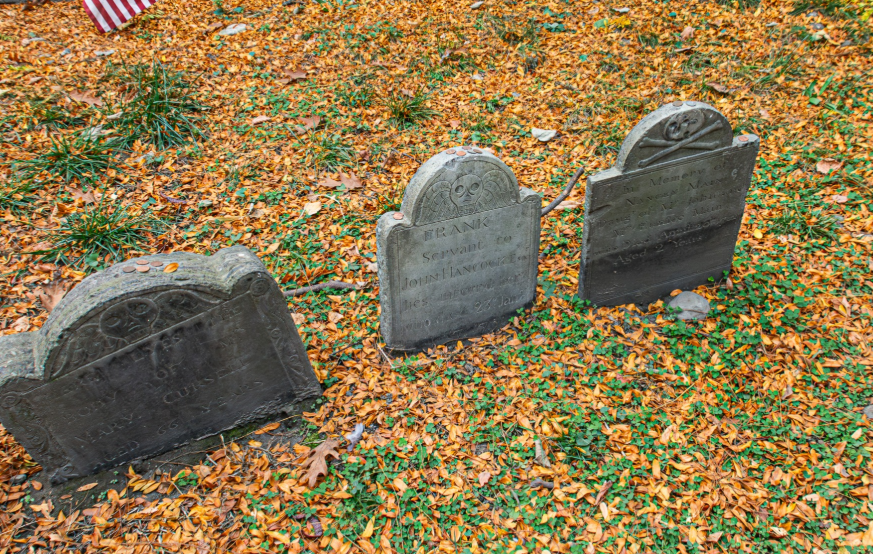
Among its most notable Revolutionary-era burials are Samuel Adams, John Hancock, and Robert Treat Paine, all signers of the Declaration of Independence; Paul Revere, patriot, craftsman, and famous midnight rider; and James Otis Jr., an influential Revolutionary-era lawyer and orator. The cemetery also contains the graves of the five victims of the Boston Massacre, including Crispus Attucks, who is often regarded as the first person killed in the confrontation.
2) King’s Chapel Burying Ground: Boston, Massachusetts
King’s Chapel Burying Ground is Boston’s oldest cemetery, established in 1630, the same year Boston was settled. The cemetery contains more than 1,000 burials, including Massachusetts’ first governor, John Winthrop, religious leader John Cotton, early printer Hezekiah Usher, and Mary Chilton, who is traditionally believed to have been the first woman to step off the Mayflower.
One of the monuments at King’s Chapel Burial Ground is for William Dawes Jr., who rode with Paul Revere to warn the colonial militia of the approaching British forces before the Battles of Lexington and Concord in 1775.
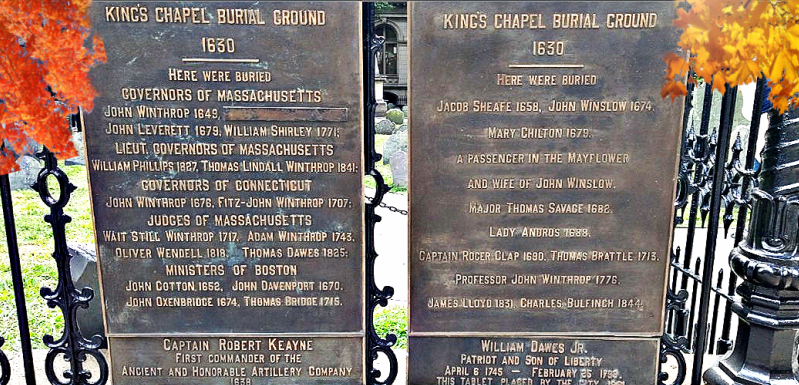
Despite its name, the burying ground has never been affiliated with a church. Its weathered slate gravestones feature classic colonial symbols such as winged skulls, hourglasses, and other reminders of mortality. Over the centuries, many of the stones were rearranged into orderly rows, so their present locations do not always correspond with the actual graves beneath them.
3) Central Burying Ground: Boston, Massachusetts
Central Burying Ground was established in 1756 on Boston Common to relieve overcrowding in Boston’s older cemeteries. The cemetery is notable for its early New England gravestone art, including death’s-heads, cherubs, and urn-and-willow designs.
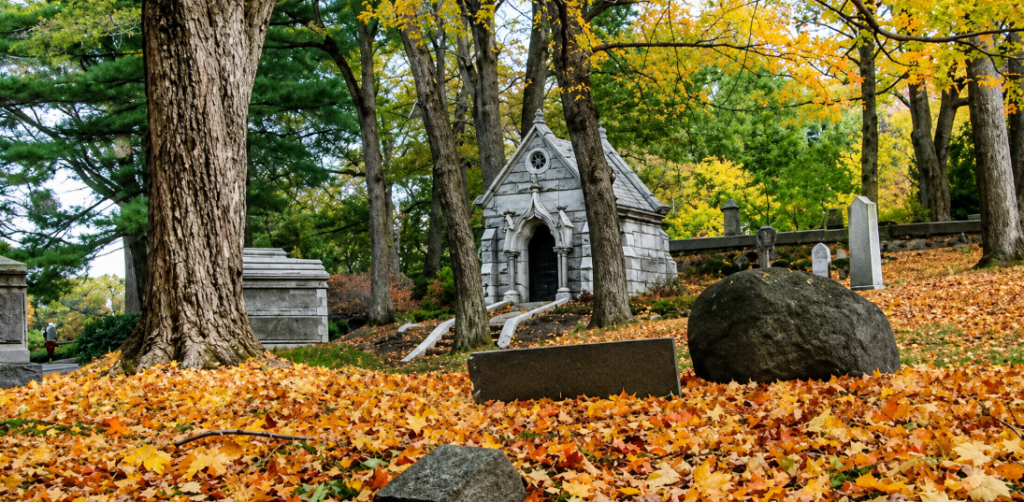
The cemetery also contains the remains of American patriots connected with the Battle of Bunker Hill and the Boston Tea Party. British soldiers who died of disease during the British occupation of Boston in 1775–1776 are also buried there.
Central Burying Ground offers a fascinating glimpse into the people who lived—and died—in Boston during the turbulent years surrounding the American Revolution.
4) Mound Cemetery: Marietta, Ohio
- Highlights: Mound Cemetery holds the graves of more Revolutionary War veterans than any other cemetery in the country. It is built around an ancient Native American burial mound. The old-growth trees turn brilliant shades of red and gold.
- Fall Color Tours Peak Foliage: Late October.
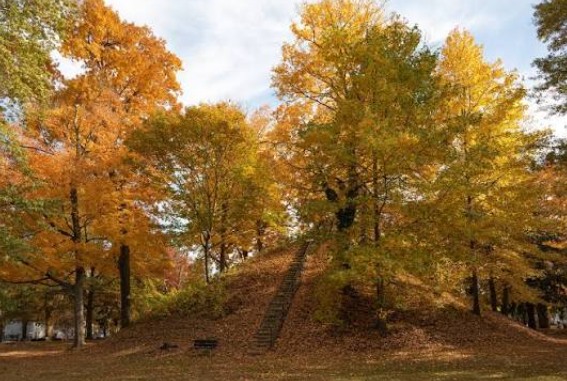
Mound Cemetery contains the graves of 37 documented Revolutionary War veterans. Notable Revolutionary-era figures buried here include:
- General Rufus Putnam, a Revolutionary War officer and founder of Marietta
- General Benjamin Tupper, another founder of the Ohio Company of Associates
- Commodore Abraham Whipple, a Continental Navy officer
- Colonel Ebenezer Sproat, an early Marietta surveyor and community leader
- Colonel William Stacy, a Revolutionary War officer who endured captivity during the war
- Griffin Greene, a Revolutionary War quartermaster.
5) Colonial Park Cemetery: Savannah, Georgia
- Highlights: This is Savannah’s oldest intact municipal cemetery. Officers and soldiers from the American Revolutionary War are buried here. Spanish moss hanging from ancient live oaks provides a distinct southern flavor of autumn.
- Fall Color Tours Peak Foliage: Late November
Colonial Park Cemetery is Savannah’s oldest intact municipal cemetery. It was established around 1750 and used as the city’s primary public burial ground until it closed in 1853. The six-acre cemetery contains more than 9,000 graves and preserves an important record of Savannah’s colonial and early American history.
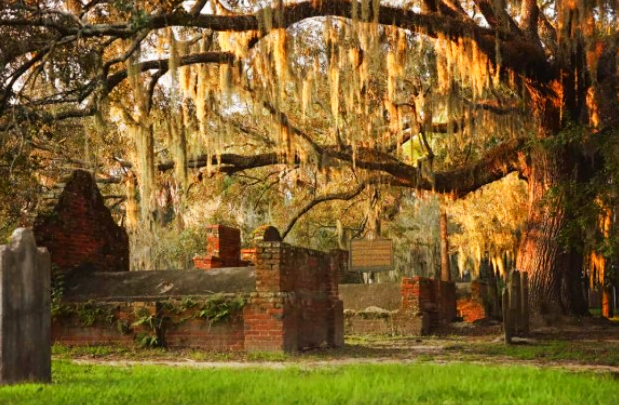
Colonial Park has especially strong connections to the American Revolution. Notable burials include:
- Button Gwinnett, a signer of the Declaration of Independence
- Samuel Elbert, a Revolutionary War soldier and governor of Georgia
- Lachlan McIntosh, a major general in the Continental Army
- Joseph Clay, a major in the Georgia Line
- Archibald Bulloch, president of Georgia’s revolutionary Provincial Congress
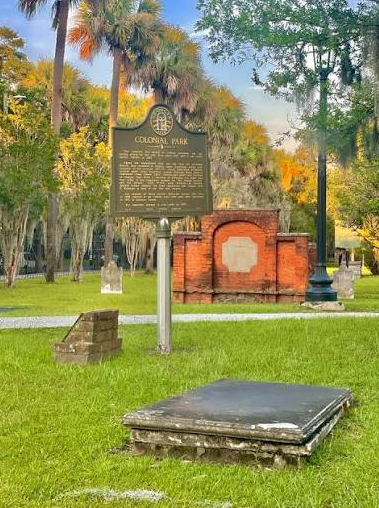
The cemetery is also connected to Nathanael Greene, one of Washington’s most important generals in the Southern Campaign. Although Greene was initially laid to rest in a vault at Colonial Park after his death in 1786, his remains were later reinterred in Johnson Square in Savannah in 1901.
With its weathered 18th- and early 19th-century gravestones, historic monuments, and Revolutionary-era burials, Colonial Park Cemetery offers a fascinating glimpse into Savannah during the struggle for American independence and the formative years of the new nation.
6) Congressional Cemetery: Washington, D.C.
- Highlights: Features active historical preservation, autumn cleanup and flag-laying events, and gravesites of early government figures and Revolutionary War patriots beneath a brilliant canopy of changing leaves.
- Fall Color Tours Peak Foliage: Late October to mid-November.
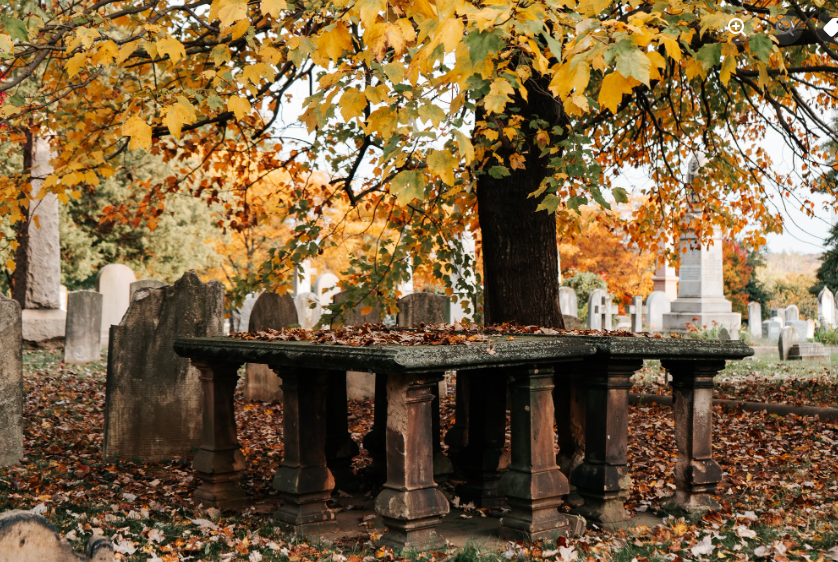
Congressional Cemetery was established in 1807 and is one of the nation’s most historically significant cemeteries. It was originally known as the Washington Parish Burial Ground.
The 35-acre cemetery contains the graves of many individuals from the Revolutionary War Era. These are some of the most notable:
- Elbridge Gerry (1744–1814) — A Massachusetts delegate to the Continental Congress and signer of the Declaration of Independence. He later served as governor of Massachusetts and as vice president under James Madison. Gerry is the only signer of the Declaration buried in Washington, D.C. (Side note: the word “gerrymandering” comes from this founder’s name.)
- Uriah Tracy (1755–1807) — A Connecticut lawyer, Revolutionary War veteran, and U.S. senator. He was the first member of Congress buried at Congressional Cemetery when he died in 1807.
- George Clinton (1739–1812) — Revolutionary War general, governor of New York, and the fourth vice president of the United States. He was buried at Congressional Cemetery in 1812.
- Theodorick Bland (1742–1790) — A Virginia physician, Continental Army officer, and member of the Continental and Confederation Congresses. He served in the Revolutionary War as a captain in the First Troop of Virginia Cavalry. His remains were later reinterred at Congressional Cemetery.
- Thomas Blount (1759–1812) — A North Carolina congressman who entered the Continental Army at age 16. He was captured and sent to England as a prisoner of war during the Revolution. He died in 1812 and was buried at Congressional Cemetery after his death in Washington.
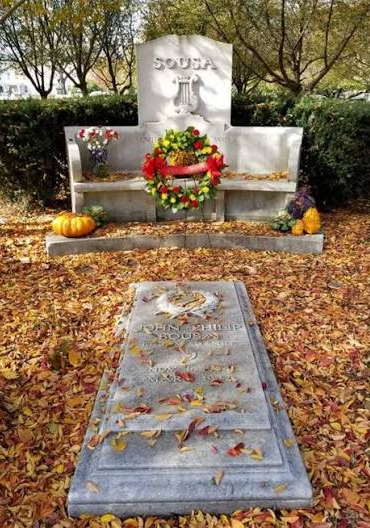
Famous composer and conductor John Philip Sousa (1854 – 1932) is also buried at Congressional Cemetery. He was laid to rest with full military honors. His gravesite features a stone slab with musical notes and a bench decorated with a carved harp. Every year on his birthday, November 6th, “The President’s Own” Marine Band holds a public graveside concert and wreath-laying ceremony to honor their former director.
7) Revolutionary War Cemetery: Salem, New York
- Highlights: rare 18th-century carvings and 100+ Revolutionary War veterans’ graves.
- Fall Color Tours Peak Foliage: The area features a high concentration of sugar maple trees that burst into vibrant reds, oranges, and golds in mid- to late-October.
Revolutionary War Cemetery, also known as Old Salem Burying Ground, is a historic graveyard in Salem, New York. Established in 1767, the 2.6-acre cemetery contains more than 1,000 graves and is listed on the National Register of Historic Places.
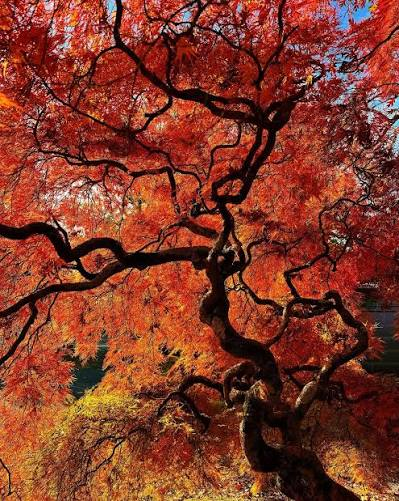
The cemetery has an especially strong connection to the American Revolutionary War. At least 100 Revolutionary War veterans are buried here. It was a burial place for casualties following nearby military actions, including the Battle of Saratoga. A large number of unidentified soldiers were reportedly buried in a mass grave after the battle.
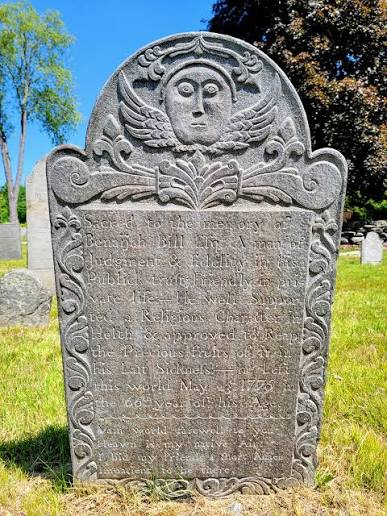
The cemetery’s early gravestones are also notable for their 18th-century artwork, including stones carved by local stonecutter Zerubbabel Collins featuring soul effigies (heads with wings) and other symbols.
With its early gravestones, burial mounds, and large number of Revolutionary War veterans and casualties, Old Salem Burying Ground offers a remarkable glimpse into the lives of those who lived through the American Revolution.
8) Mount Vernon Estate: Fairfax County, Virginia
- Highlights: The historic trees across the Potomac River estate transition through rich shades of orange, gold, and red
- Fall Color Tours Peak Foliage: Mid to Late October
George Washington, military general and first president of the United States of America, is buried at the Mount Vernon estate in Fairfax County, Virginia, in the Washington family tomb. The Mount Vernon estate rests on the banks of the Potomac River, about 15 miles south of Washington, D.C., and 8 miles south of Old Town Alexandria.
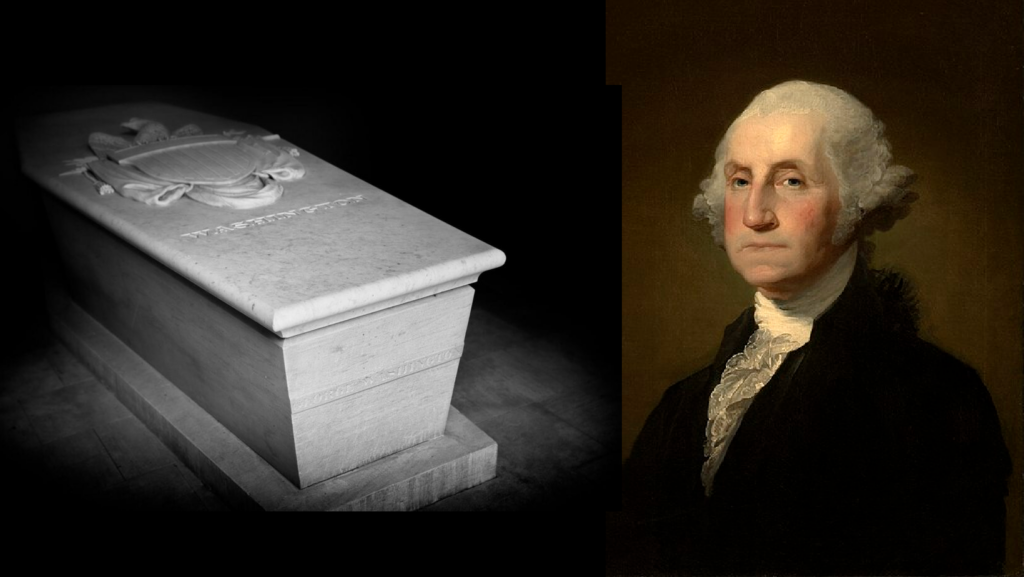
The remains of his wife, Martha Dandridge Custis, and 25 other family members are also entombed there. Although George Washington never had any biological children, he was surrounded by a rather large family made up of stepchildren, siblings, nieces, nephews, and step-grandchildren.
Washington died at home in his bedchamber on December 14, 1799. His final will expressed his wish to be buried at Mount Vernon.
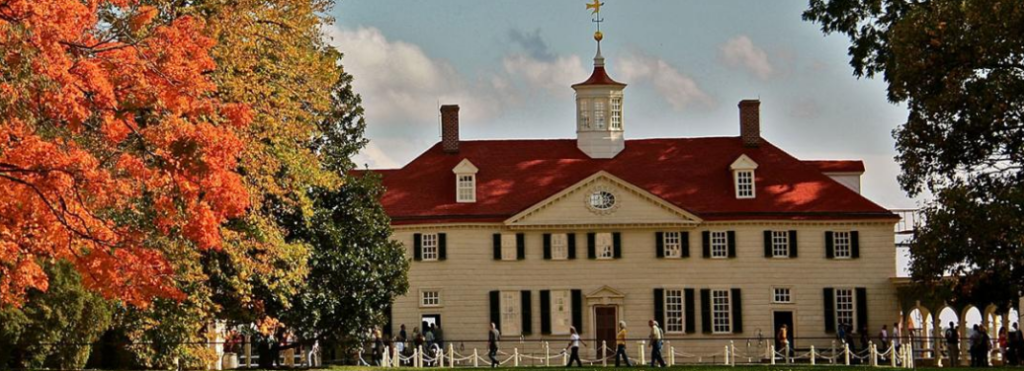
Before his death, the family’s burial vault was deteriorating, so Washington made provisions for a new brick tomb to be constructed after his passing. In 1831, Washington’s body was transferred to the new tomb, along with the remains of his wife and other family members.
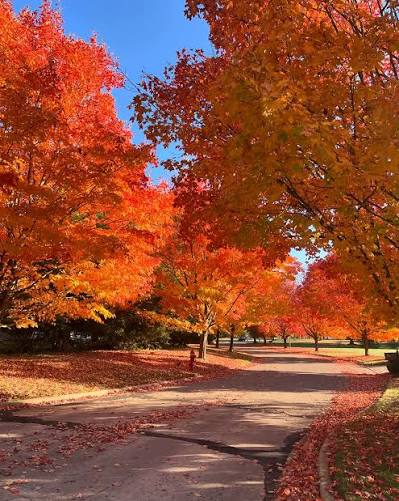
Today, the wooded grounds and brick entry surrounding the Washington family’s final resting place are a fitting legacy to honor the first president of the United States and his family.
Click HERE to learn more about George Washington’s gravesite.
9) Princeton Cemetery: Princeton, New Jersey
- Highlights: Often called the “Westminster Abbey of the United States,” this is the final resting place for U.S. Presidents, signers of the Declaration of Independence, and generations of scholars
- Peak Foliage: Mid to Late October
If you’re exploring Revolutionary War history, Princeton Cemetery is definitely worth a stop. Established in 1757, this beautiful cemetery sits right in the heart of Princeton and is filled with nearly 19 acres of history. It’s the final resting place of generations of Princeton residents, including politicians, scholars, military veterans, and some pretty important names from the American Revolution.
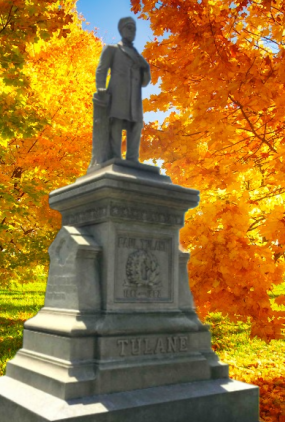
One of the biggest names here is John Witherspoon, president of the College of New Jersey and the only college president to sign the Declaration of Independence. You’ll also find Aaron Burr Sr., a prominent minister and college president. His son, Aaron Burr Jr., went on to become vice president of the United States and served as a Continental Army officer during the Revolution.
The cemetery is also the final resting place of numerous Revolutionary War veterans, including those who fought in the Battle of Princeton, which took place in January of 1777, just down the road.
10) Christ Church Burial Ground: Philadelphia, Pennsylvania
- Highlights: Mature trees surround historic 18th-century grave markers, including the gravesite of Benjamin Franklin
- Fall Color Tours Peak Foliage: Late October
Christ Church Burial Ground is one of Philadelphia’s most important American Revolutionary-era cemeteries. Established in 1719, this two-acre burial ground contains about 1,400 marked graves and is the final resting place of more than 4,000 individuals. Five signers of the Declaration of Independence are buried here.
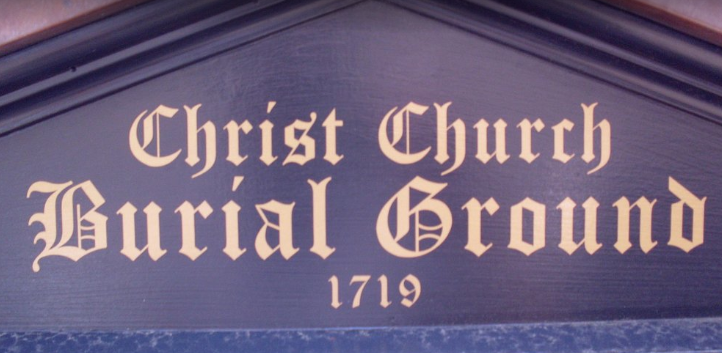
It is the final resting place of Benjamin Franklin and his wife, Deborah. Their daughter, Sarah Franklin Bache, who helped organize fundraising efforts for the Continental Army during the Revolution, is also buried here.
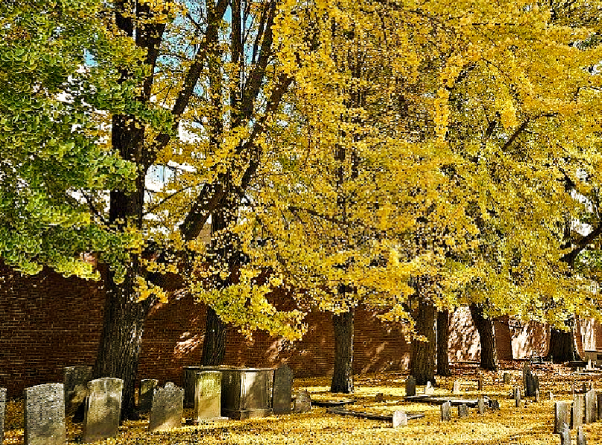
Christ Church Burial Ground provides a remarkable connection to the people who shaped early American history. Its weathered gravestones and historic markers preserve the memory of Philadelphia’s citizens, patriots, physicians, printers, military leaders, and Founding Fathers.
Notable Burials
William Jackson: Secretary of the Constitutional Convention.
Benjamin Franklin: Signer of the Declaration and the Constitution, diplomat, and scientist.
Benjamin Rush: Signer of the Declaration and a pioneer of medicine.
Francis Hopkinson: Signer of the Declaration and designer of early American flags.
George Ross: Signer of the Declaration of Independence.
Joseph Hewes: Signer of the Declaration of Independence.
Tips for Your Tour
Verify Peak Color Dates: Consult the Fall Foliage Color Map to get real-time fall foliage updates on an interactive map. Or check out The Old Farmer’s Almanac Peak Leaf Color Forecast to plan your leaf-peeping adventure.
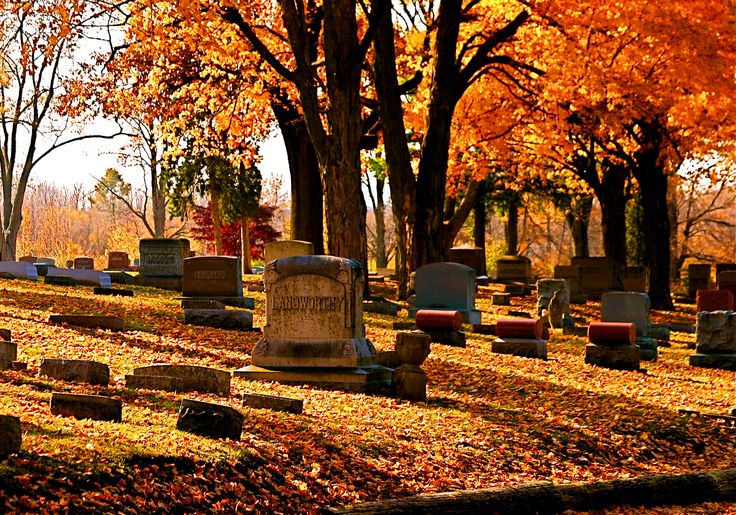
Photography: Morning light or late afternoon “golden hour” offers the best contrast between the brilliant fall canopy and the weathered colonial headstones. Use the BillionGraves app on your phone to automatically capture the GPS locations.
Check Local Event Calendars: Look for special seasonal events tied to the ongoing America250 semiquincentennial commemorations, which often feature guided lantern or flag-laying tours in the autumn months.
Check Operating Hours: Many historic urban burying grounds close around dusk or 4:00 PM.
Respect the Grounds: Stick to designated paths to avoid stepping on fragile historic slate or sandstone markers.
Preserve Old Headstones: Do not use chalk rubbings, which can damage fragile or flaking stones. Rather, use the BillionGraves app on your phone to record the data. If needed, use a mirror to reflect additional light onto the names and dates.
Explore More
In honor of America’s 250th anniversary, BillionGraves has 3 exciting tour itineraries for you! Discover 60 gravesites of the nation’s founding fathers and American Revolutionary heroes – virtually or in person. The tours include:
Click HERE to view them all.
A Special Offer for New Subscribers
You can locate the exact resting places of your ancestors, see who rests near them, and begin putting the pieces of your family’s past together in one place. We are making it easier than ever for new subscribers to start.
For a limited time, first-time subscribers can begin researching and preserving their family’s story for just $2.50 a month. This is the lowest price BillionGraves has ever offered, thanks to our America 250th Anniversary Celebrations. Click HERE to claim the offer.

Find Your Ancestors’ Gravestones

Would you like to find your ancestor’s gravestones? Whether you are visiting a cemetery in person or doing research from home, BillionGraves is a great resource. Click HERE to learn more about how to find your ancestors’ gravestones when you are at a cemetery. Click HERE to learn how to research from home.
Take Gravestone Photos
If you take pictures of the gravestones in your area and I take pictures of the gravestones in my area, we’ll all be able to find our ancestors!

Please consider documenting your local cemeteries and/or taking photos when you are on vacation. Learn how and watch a video HERE.
Learn More
Check out these related blog posts:
- 10 Best Fall Foliage Trips
- Gravestone Symbols of the American Revolution
- 20 Gravestone Angels from Colonial America
- Autumn Cemetery Color Tours
- Finding the Family of America’s Founding Fathers

Happy Cemetery Hopping! Happy Birthday, America!
Cathy Wallace